
What Makes Artisan Product Photography Different (and How to Nail It)
Mass-market brands can rely on volume and uniformity; independent makers live and thrive on nuance. Product photography for artisans is about conveying touch, time, and technique—qualities that set handcrafted goods apart. Where commercial packshots chase sterile perfection, artisan imagery should honor the small variations that prove a human made the piece. That means lighting and composition choices that emphasize texture, surface transitions, and the story coded into materials: the grain in a wooden handle, the hammered facets on a silver band, the subtle glaze crackle on a ceramic cup.
Start with light that flatters detail without flattening it. Soft, directional light—think a large window with diffusion or a big softbox—preserves micro-contrast in fibers, leather, and metal. Use reflectors or white cards to lift shadows without erasing dimensionality. For jewellery and high-shine pieces, control specular highlights with larger light sources placed farther back; a bigger apparent light makes a cleaner, more luxurious reflection. Keep blacks deep but not crushed, and aim for balanced highlights that don’t clip, so edits retain latitude.
Color accuracy is credibility. Hand-dyed textiles, natural gemstones, and small-batch glazes can look wildly different under mixed light. Set custom white balance, include a gray card shot for reference, and profile your camera if possible. The goal is faithful representation that reduces returns and builds trust. When in doubt, include one image that shows the item in daylight context—near a window or outdoors in open shade—where audiences instinctively read color more accurately.
Composition should be intentional but unfussy. Use negative space to let forms breathe and guide the eye with leading lines or props that belong to the craft (a burnisher next to a leather wallet, a raw clay coil beside a finished bowl). Scale is crucial for online buyers: add a hand, a coin, or common objects to communicate proportions. Finally, plan for consistency. Establish background tones, horizon height, crop ratios, and angles that repeat across the collection. Consistent sets make small-batch releases feel like a cohesive brand rather than a string of one-offs.
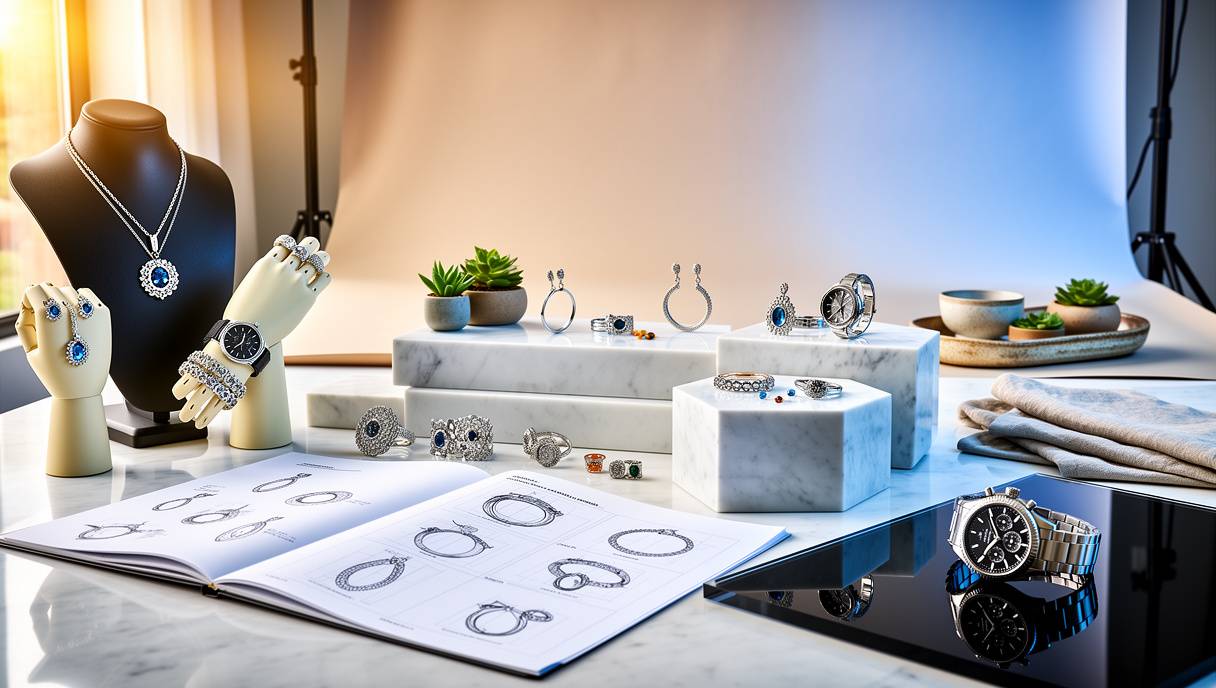
A Practical Workflow: From Prototype to Shop-Ready Images
Great artisan images begin long before the shutter clicks. Define your intent: are you shooting for a product page, a launch email, or a wholesale line sheet? List your must-haves: a hero shot, three-quarter angle, straight-on packshot, macro details, in-hand scale, back/underside, clasp or closure, and packaging. A simple shot list prevents gaps that can stall listings and sales.
Build a quick visual plan. Choose a color palette that complements materials—cool gray for polished steel, warm beige for rattan and oak, charcoal for bright enamels. Create a small prop library from the workshop itself: pattern paper, raw offcuts, tools with patina. These reinforce authenticity without stealing the scene. For backgrounds, foam boards, linen tablecloths, and matte acrylic sheets offer neutral, nonreflective bases. Keep a lint roller and soft brush handy; prevention beats retouching.
On set, prioritize stability and repeatability. Mount the camera on a tripod, frame slightly wider than needed, and mark product positions with painter’s tape. Typical settings for crisp detail: f/8–f/11, ISO 100–400, and a shutter speed that suits your light (use a remote or timer to avoid shake). Lock white balance and use a gray card frame for each setup. For reflective metals, experiment with flagging (blocking light) to sculpt shape; small black cards at the edges of jewelry can increase edge definition without heavy post-production.
Editing should respect the craft. Apply global adjustments first—exposure, contrast, white balance—then perform minimal cleanup: dust spots, stray fibers, surface specks. Avoid over-smoothing or excessive saturation that misrepresents finishes. Export platform-ready crops (1:1 for marketplaces, 4:5 for social feeds, 3:2 or 16:9 for banners) and prepare high-resolution files for print and press kits. When your schedule is tight or you need multiple variants fast, a modern visual production platform can speed things up—turning sketches or CADs into lifelike renders, generating on-model shots, or swapping backgrounds while keeping shadows and reflections intact. For makers who want scalable, studio-quality results with minimal setup, Product photography for artisans streamlines this entire pipeline, from packshots to lifestyle scenes, without sacrificing realism.
Selling Across Platforms: E-commerce, Social, and Wholesale
Each channel has its own visual language and technical rules, and artisans who adapt earn more attention with less effort. On e-commerce product pages, clarity converts. Lead with a clean white or neutral background packshot that shows true color and form. Follow with three to five supportive images: macro details (stitches, facets, grain), scale-in-context (in hand, on a tabletop), and one lifestyle scene that hints at use. Prioritize fast-loading but crisp assets—2K is often enough for most storefronts, while 4K master files future-proof new layouts and zoom features.
Marketplaces like Etsy and Amazon reward consistency. Check image guidelines for minimum dimensions and allowed backgrounds; many prefer square crops, centered subjects, and bright, evenly lit images. Use filenames and alt text that describe material, form, and use case: “hand-thrown-stoneware-cereal-bowl-20oz–speckled-glaze.jpg” beats “IMG_1234.jpg” for search visibility. For local SEO, include regional phrases in captions or descriptions when appropriate—“handmade leather wallet from Austin workshop”—to attract nearby buyers who care about provenance.
Social media favors storytelling and sequence. A carousel can narrate your process: raw material, tool in action, artisan at work, finished piece, then detail macros. Vertical crops (4:5 and 9:16) fill screens and out-perform pure square in many feeds. Mix polished shots with behind-the-scenes clips to build trust; audiences respond to the proof of hand and the rhythm of making. Short videos and subtle motion (a turntable clip of a ring catching light, steam rising from a ceramic mug) complement stills and boost engagement without heavy production.
Wholesale and press require another layer of professionalism: uniform backdrops, exact dimensions, and a broader range of angles so buyers can evaluate quickly. Include packaging and variations together (sizes, finishes), and provide a clean contact sheet. Consider a consistent on-model look for wearables—necklace falls, ring stacks, scarf drape—using diverse skin tones and minimal styling so the product remains the hero. If arranging live shoots is difficult, virtual model imagery can bridge the gap while keeping brand aesthetics intact.
Real-world scenarios prove the impact. A ceramicist who swapped mixed lighting for a single soft source saw glazes read truer and returns drop. A jeweler who adopted macro detail plus in-hand scale images improved conversion on small-ticket items where size was unclear. A leatherworker who standardized crops and backgrounds across 30 SKUs reported faster wholesale approvals and a more cohesive catalog. The throughline is simple: consistency, clarity, and craft-centric detail win trust. Whether shooting in a sunlit studio corner or building scenes in a digital workspace, the right images let buyers feel what you’ve made—and that feeling is what sells.

Belgrade pianist now anchored in Vienna’s coffee-house culture. Tatiana toggles between long-form essays on classical music theory, AI-generated art critiques, and backpacker budget guides. She memorizes train timetables for fun and brews Turkish coffee in a copper cezve.